

Managing Variable Pay and Bonuses Correctly
18 May 2026
Editor: ET
Employee rewards play an important role in motivation, retention, and workplace culture. For businesses in Singapore, managing variable pay and bonuses correctly is not only about rewarding performance—it is also about ensuring payroll accuracy, tax compliance, and financial clarity.
As companies grow, compensation structures often become more complex. Bonuses, incentives, commissions, and performance-based payouts require proper planning and documentation to avoid payroll errors or reporting issues. With practical insights aligned with Expede, this article explores how businesses can manage variable pay effectively while staying compliant and organised.
Further Reading: Reduce Costs with Better Accounting for SMEs
Understanding Variable Pay
Variable pay refers to compensation that changes based on performance, company results, or predefined targets. Unlike fixed salaries, these payments are not guaranteed at the same amount every month.
Common examples include:
Performance bonuses
Sales commissions
Incentive payouts
Annual variable bonuses
Profit-sharing arrangements
Variable pay helps businesses align employee rewards with performance and business goals. However, because these payments fluctuate, they require careful payroll management.
Why Proper Management Matters
Variable pay may seem straightforward, but inaccurate handling can create several issues, including:
Payroll discrepancies
Incorrect tax reporting
Employee misunderstandings
Compliance concerns
Clear processes ensure that employees are paid correctly while businesses maintain accurate financial and payroll records.
In Singapore’s compliance-focused environment, structured payroll practices are essential for maintaining trust and operational efficiency.
Create Clear Compensation Policies
One of the most important steps is establishing a clear and transparent policy for variable pay.
Businesses should define:
Eligibility criteria
Calculation methods
Payment schedules
Performance metrics
Employees should understand how bonuses are determined and when payouts are expected. Transparency reduces confusion and strengthens confidence in the compensation process.
Document Everything Properly
Variable pay should always be supported by proper documentation. This includes:
Bonus approval records
Performance evaluations
Commission calculations
Internal authorisations
Well-maintained documentation helps businesses:
Verify payment accuracy
Support payroll reporting
Respond to audits or queries efficiently
Good record-keeping also ensures consistency across departments and payroll cycles.
Ensure Accurate Payroll Processing
Bonuses and incentives must be correctly reflected in payroll calculations. This involves:
Including the correct payment amount
Applying relevant deductions
Recording payments in the appropriate payroll period
Errors in payroll processing can lead to overpayments, underpayments, or inaccurate reporting to authorities.
Using structured payroll systems reduces manual errors and improves consistency.
Understand Tax Treatment of Bonuses
In Singapore, bonuses and variable payments are generally taxable and must be reported correctly.
This includes:
Annual bonuses
Performance incentives
Cash commissions
Businesses must ensure that:
Bonus payments are accurately included in employee income reporting
Payroll records align with tax submissions
Supporting calculations are retained
Incorrect reporting can lead to discrepancies during tax reviews.
Consider CPF Contributions Carefully
For Singapore citizens and permanent residents, CPF contributions may apply to certain types of variable pay.
Businesses should determine:
Which payments are CPF-applicable
Contribution ceilings and limits
Correct employer and employee contribution amounts
Miscalculations in CPF contributions can result in compliance issues or adjustments later.
Manage Cash Flow Before Bonus Periods
Bonus payouts can significantly impact business cash flow, especially during year-end periods.
To manage this effectively, businesses should:
Forecast bonus obligations early
Allocate sufficient funds in advance
Avoid last-minute financial strain
Planning ahead allows companies to reward employees confidently without affecting operational stability.
Align Variable Pay with Business Performance
Variable pay should support sustainable business growth. Instead of offering inconsistent or unclear incentives, businesses should align bonus structures with:
Company performance
Department goals
Individual contributions
This creates a healthier balance between employee motivation and financial responsibility.
Communicate Clearly with Employees
Compensation discussions can be sensitive. Businesses should communicate:
How bonuses are calculated
Whether payouts are discretionary or contractual
Any changes to incentive structures
Clear communication reduces misunderstandings and helps maintain positive employee relationships.
Use Technology for Better Accuracy
Manual payroll handling increases the risk of mistakes, especially when managing multiple bonus structures.
Payroll systems can help businesses:
Automate calculations
Maintain accurate records
Track historical payouts
Generate payroll reports efficiently
Technology improves both accuracy and operational efficiency.
Further Reading: Singapore Tax vs Global Rates for SMEs
The Role of Professional Payroll Support
As payroll structures become more complex, professional support becomes increasingly valuable.
Experienced payroll and accounting professionals can help businesses:
Ensure accurate payroll processing
Manage CPF and tax reporting correctly
Maintain proper documentation
This reduces administrative pressure and allows businesses to focus on growth and employee engagement.
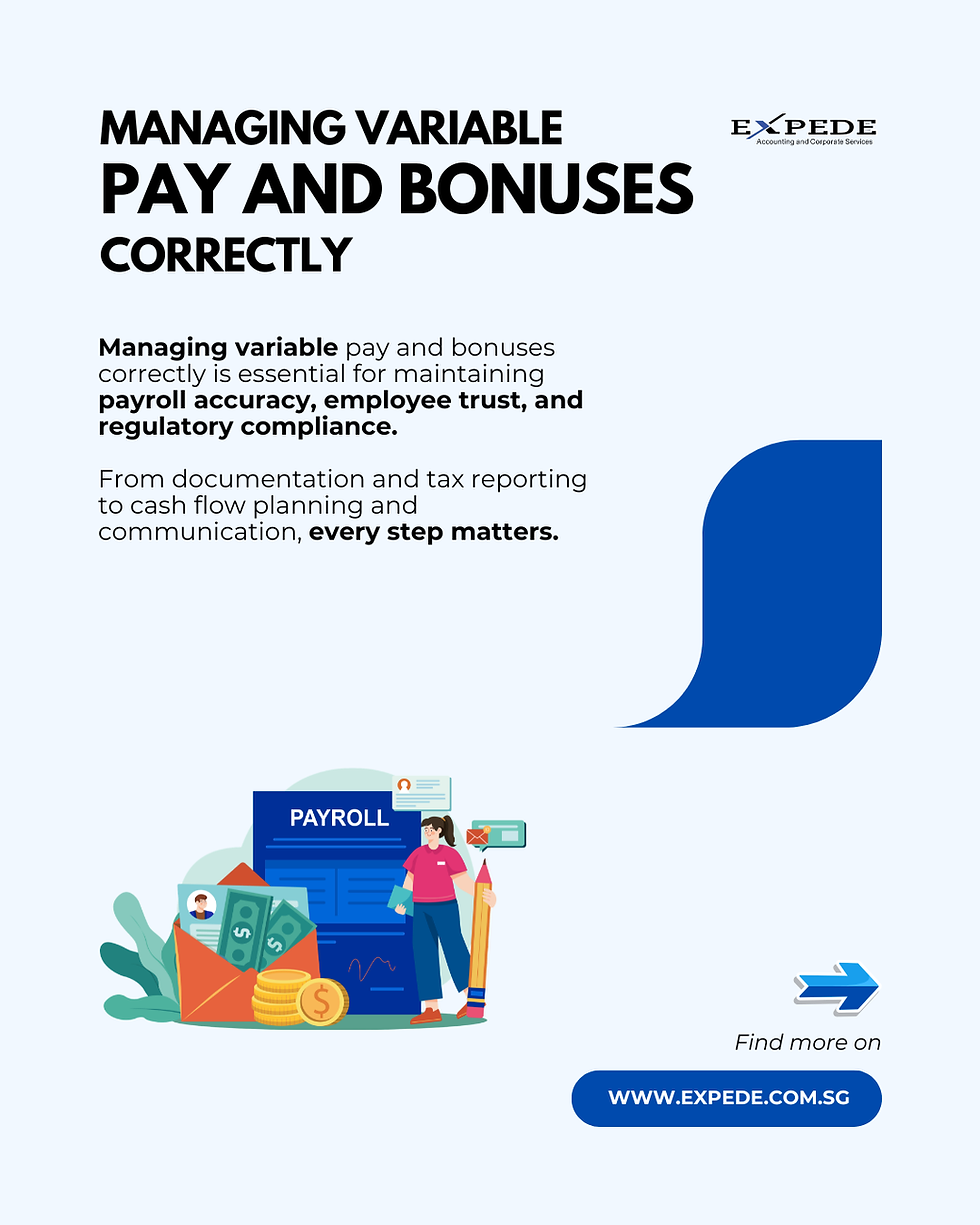
Managing variable pay and bonuses correctly is essential for maintaining payroll accuracy, employee trust, and regulatory compliance. From documentation and tax reporting to cash flow planning and communication, every step matters.
In Singapore’s structured business environment, businesses that approach compensation with clarity and organisation are better positioned to grow sustainably while maintaining strong workforce relationships.
Ultimately, well-managed bonus systems are not just about rewarding performance—they reflect professionalism, transparency, and strong financial management.


Comments